The Hidden Cost of BPS Non-Compliance: Tenant Risk in Benchmarked Cities
Fines are the visible cost of Building Performance Standard non-compliance. Tenant defection is the hidden one — and it's often bigger. Here's how BPS exposure shows up in leasing outcomes.
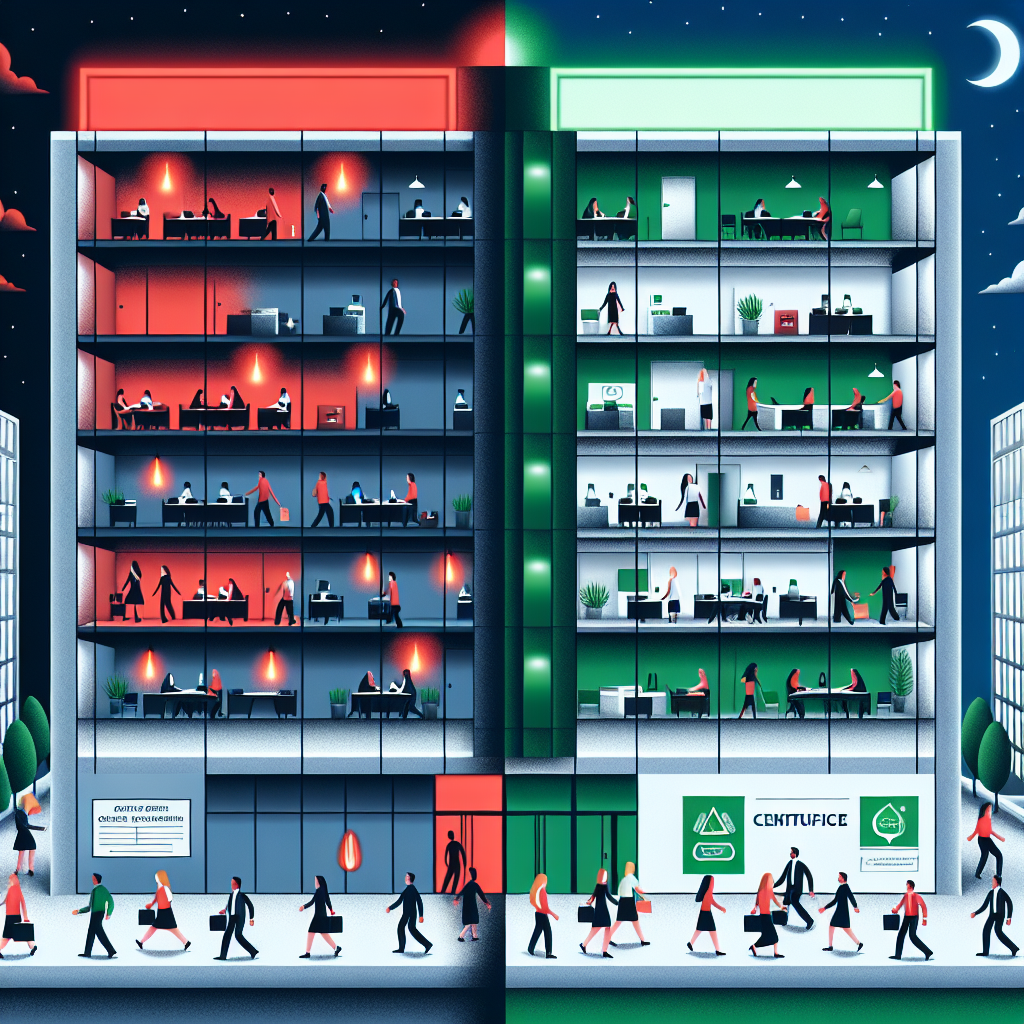
When owners and operators calculate the cost of Building Performance Standard (BPS) non-compliance, they usually focus on the obvious number: the annual Alternative Compliance Payment. A Class B office exceeding LL97's 2030 cap by 300 tons pays $80,400 per year — an unpleasant but boundable expense.
That calculation is incomplete. The hidden cost of non-compliance — tenant defection, leasing velocity loss, and rent concession inflation — is often larger than the fine itself. This guide explains how BPS exposure flows into leasing outcomes and why the total cost picture matters.
The four hidden cost categories
1. Tenant defection at renewal
Corporate tenants with internal sustainability commitments — now a meaningful share of Fortune 1000 — have begun weighing BPS compliance in renewal decisions. A tenant with a 40% Scope 3 reduction commitment cannot credibly renew in a building whose emissions are rising and which faces public non-compliance.
The defection rate varies by tenant type. For large corporate tenants with published sustainability commitments (increasingly common), BPS non-compliance is one of the top 3 reasons cited for non-renewal in recent broker surveys. For smaller tenants without formal ESG commitments, the factor is less acute — but still present.
Typical impact: a Class B office with visible BPS non-compliance sees 10–25% higher renewal attrition from sustainability-committed tenants compared to compliant peers.
2. Extended lease-up on vacated space
When a non-compliant building has vacancy, the time-to-lease is structurally longer than equivalent compliant buildings. Prospective tenants screen out non-compliant buildings during site selection, reducing the effective tenant pool.
Typical impact: +2 to +6 months longer time-to-lease on a non-compliant Class B office vs a compliant peer in the same submarket. At $6–8 per square foot in market rent, that's substantial carrying cost.
3. Rent concessions and TI escalation
To close deals in non-compliant buildings, owners typically have to offer larger concession packages:
- Additional free rent months.
- Increased tenant improvement allowances.
- More aggressive escalation caps.
- Sustainability commitment clauses (owner committing to specific retrofit timelines).
These concessions compound. A deal that would have closed at face rent in a compliant building might close at a 15% effective discount in a non-compliant one.
4. Asset-level cap rate adjustment
As the tenant-side patterns above become visible in market-wide lease comps, they flow into valuation. Institutional buyers now apply cap rate expansion to non-compliant Class B office, typically 25–75 basis points above the compliant comp.
For a Class B office with $3M NOI, a 50 basis point cap rate adjustment is roughly $6M of asset value.
The tenant types most affected
Fortune 500 with published ESG commitments: high sensitivity. Will pay a premium for compliant buildings and defect from non-compliant ones at renewal. Growing share of corporate real estate demand.
Tech and financial services: mixed sensitivity. Many have aggressive sustainability programs; smaller firms may be less formal. Google, Microsoft, Amazon, Apple, and major banks all publish detailed ESG targets.
Law firms and professional services: rising sensitivity. Client RFPs now often include sustainability questions that pass through to office choices.
Government and institutional tenants: high sensitivity. Federal (GSA), state, and increasingly municipal tenants have hard requirements for ENERGY STAR or equivalent certifications.
Small to mid-size business tenants: low to moderate sensitivity. Price and location dominate. BPS status matters less — for now. This is changing.
Startups and creative: variable but increasing. Many early-stage companies publish sustainability commitments tied to recruiting.
How tenant RFPs have changed
A decade ago, tenant RFPs contained a line or two on sustainability — typically aspirational and non-binding. Today, sophisticated corporate tenant RFPs include specific, measurable questions:
- What is the building's current ENERGY STAR score?
- What is the building's current BPS compliance status?
- What is the owner's retrofit plan for 2030 compliance?
- Will the landlord commit to specific emissions performance?
- Will the landlord provide annual energy/emissions disclosure to the tenant?
- Does the lease include emissions-based rent caps?
A building that cannot answer these questions well is structurally disadvantaged in the RFP process.
The emissions pass-through clause
An increasingly common lease structure in BPS markets is the emissions pass-through: if the landlord incurs BPS fines or ACPs, those costs are passed through to tenants as part of operating expenses.
This is a double-edged arrangement:
- For the landlord — it partially insulates against BPS fine exposure.
- For the tenant — it creates a direct financial interest in the building's compliance status.
Tenants negotiating with pass-through clauses now demand disclosure of the landlord's retrofit plan, and often cap their pass-through exposure. A tenant won't accept unlimited emissions pass-through without a compliance trajectory.
The green lease phenomenon
A "green lease" includes specific sustainability provisions:
- Energy performance targets.
- Tenant/landlord cooperation on retrofits.
- Annual energy data sharing.
- Cost-share for capital improvements.
- Penalties for non-performance.
Green leases are becoming standard for large corporate tenants in BPS cities. A landlord unwilling to negotiate green lease terms will lose these tenants to landlords who are.
The leasing velocity math
Consider a typical 150,000 sq ft Class B office with 30% rollover in the next 24 months:
- 45,000 sq ft in rollover space.
- If 20% of that space experiences extended vacancy due to BPS non-compliance: 9,000 sq ft with +3 months additional lease-up.
- At $55/sq ft market rent: $123,750 in additional carry cost.
Plus:
- Increased concessions on the renewed/replaced space: ~10% effective rent reduction.
- 45,000 sq ft × $55 × 10% × 5 years average term = $1,237,500 NPV loss.
Plus the direct BPS fine ($80,400/year, $400,000 NPV over 5 years).
Total hidden cost: ~$1.75M NPV on a single 150,000 sq ft Class B office. The direct BPS fine is less than a quarter of the total.
The strategic implications
For owners: BPS compliance is not an optional ESG add-on. It is a core leasing competitiveness investment. The retrofit math must include hidden costs, not just fines.
For brokers representing owners: non-compliance is a leasing weakness that must be actively managed. Compliance trajectory should be part of every marketing package.
For brokers representing tenants: BPS compliance status should be part of every site evaluation. Tenants who don't check are accepting hidden costs they haven't budgeted.
For lenders: underwriting models need to include leasing velocity adjustments on non-compliant buildings, not just fine projections.
For investors: asset-level cap rate adjustments for BPS non-compliance are real and growing. Portfolio-level compliance trajectory becomes a valuation driver.
Where the data is visible
Much of this hidden cost is already visible in public data:
- NYC LL97 compliance status — public.
- BERDO disclosure status — public.
- BEPS compliance — public.
- EWRB filing — public.
- Lease comps in non-compliant buildings — increasingly trackable through CoStar and similar.
A sophisticated counterparty — a tenant, a lender, an acquirer — can already see which buildings are compliant and which are not. The information asymmetry is closing fast.
What to do about it
For owners of non-compliant Class B office:
- Run a current compliance assessment against all relevant BPS caps.
- Develop a detailed retrofit plan with costs, timing, and projected compliance impact.
- Communicate the plan to current tenants (builds trust, reduces defection).
- Include the plan in all new tenant RFPs (improves win rate).
- Consider green lease terms to formalize landlord-tenant collaboration.
- Budget for the retrofit as a competitive necessity, not an ESG option.
For tenants in non-compliant buildings:
- Request disclosure of current emissions and retrofit plan before renewal.
- Negotiate caps on emissions pass-through.
- Consider green lease terms for long-term commitments.
- Compare renewal terms against credible compliant alternatives.
Closing
The fine is the tip of the iceberg. The hidden cost — tenant defection, leasing velocity loss, concession inflation, and cap rate expansion — is usually larger than the fine itself. Owners who treat BPS compliance as a checkbox miss the real economics. Owners who treat it as a competitive leasing investment outperform. In the 2025–2030 window, the spread between these two strategies will materially separate winning Class B portfolios from losing ones.